
US Export Sales and Shipments
- Tuesday March 17, 2009
This analysis featured on the HGCA's Website Analysis in March 2009.
With the high level of outstanding sales cumulated last year being worked off, prospects for US export shipments of wheat and maize are being maintained above levels indicated by current sales. However, the favourable rate of soyabean sales is not expected to be sustained for the balance of the crop year.
US Grain and Oilseed Trade Reporting
Since 1972, the US has had a very detailed and timely system for reporting of grain and oilseed export sales. That was the year when the Soviet Union, after committing to increasing domestic food consumption, suffered a serious drought and was compelled to import unprecedented quantities of grain, initially from the US which was granting export subsidies at the time. The magnitude of the Soviet business and the futility of the subsidies only became apparent weeks later.
To ensure this did not happen again, the US Department of Agriculture (USDA) instituted a programme, run by its Foreign Agricultural Service, for reporting export sales of grains, oilseeds and some other farm commodities. Weekly reports are made generally on Thursdays covering the week ending the previous Thursday. This sales data can provide valuable insight into eventual export shipments, even if sales are on occasion cancelled.
Data on export shipments are assembled from grain inspections by the USDA’s Grain Inspection, Packers and Stockyards Administration (GIPSA) and published weekly, on Mondays for the period also covering the week ending the previous Thursday.
US customs collects US trade data which are compiled and published on a monthly basis by the US Department of Commerce and include both physical volumes and trade value. And, all this is distinct from the forecasts of crop year exports, revised monthly, by the USDA’s World Agricultural Outlook Board.
Wheat
At the start of the current, 2008-09 crop year in June, wheat export sales, made earlier for subsequent shipment, stood at 7.2Mt, more than 50% above the previous year and the five-year average (Graph 1). While there was some seasonally typical increase in outstanding sales over the summer months, this, in contrast to the previous year, was not sustained. Between July and November about 10Mt of wheat export sales were made this crop year, compared to about 20Mt the previous crop year.
continue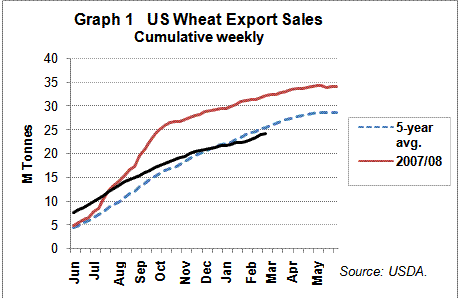
The motivation for the very heavy commitment to US purchases early in 2007/08 was the very tight global supply situation. The relative slow pace of commitment this year reflects the reality of a record global wheat crop and more adequate supplies.
The recovery of European and Black Sea port supplies has also changed the geographic distribution of US wheat sales this year (Graph 4). The loss of sales, particularly to North Africa, has been significant, although in absolute terms this market is probably not as important to the US as the Asian market.
continue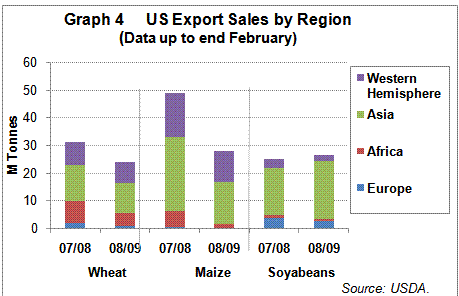
The US crop year export shipments are forecast by the USDA to decline by 20%. They are currently running about 23% below last year’s pace. In this context concern has frequently been expressed about US wheat not being priced competitively in Mediterranean basin markets and that US wheat export sales are not keeping pace with even the reduced export shipment forecasts.
This concern may be overstated. Much of the decline in cumulative export sales this year has been offset by the decline in outstanding sales which had ballooned last year. A return to more usual buying practices prompted by improved supplies is likely to result in deferred as much as reduced business for US wheat in Asian as opposed to European markets.
Maize
Maize export sales were running 43% below year ago levels and 21% below the five-year average at the end of February. Given the record 2007 crop and thus increased supplies, even after allowance for expanding domestic use, a rise in exports was expected from the start of last season. Export sales last year led average sales for the last five years for the whole crop year (Graph 2).
continue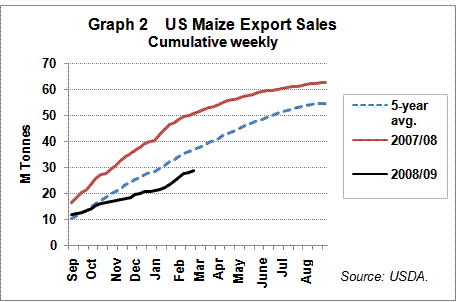
This year, however, export prospects look increasingly uncertain, following a smaller US crop and deteriorating economic conditions, The USDA’s projected seasonal export shipments is 44.5Mt, 28% below last year. Much of the difference between this and the 43% decline in actual sales to-date is currently covered by declining outstanding sales.
As the US is such a major player in the international marketplace, overall demand prospects are probably as important as competitive factors. The European market has not been important to the US. The abundance of feed quality European wheat may therefore not be overly important to aggregate US maize export prospects, even if some EU wheat finds its way into US maize markets.
But the Asia market is critical to the US. Weekly sales reports over the last six weeks have been relatively promising for this market. As with wheat, the earlier lag in sales may reflect the choice of buyers, in the context of improved global grain supplies and uncertain demand conditions, to defer purchases for as long as possible.
Soyabeans
US soyabeans export sales were not materially affected by the very tight global wheat supply situation and record prices last season (Graph 3). US soyabeans and oilseeds generally were in adequate supply at the beginning of 2007/08. US soyabean exports were sustained by running down ending stocks and at 31.3Mt were 9% above the five-year average. At the same time global oilseed output declined for the first time in many years.
continue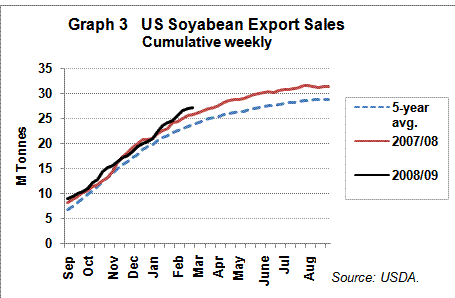
This season’s US soyabean exports however have been dependent on a larger crop, given the very reduced beginning stocks. To the end of February, export sales were 27.1Mt, 5 and 14% above last year and the five-year average. Two factors which are unlikely to be sustained appear to have limited the possible impact of deteriorating economic conditions on US export sales. Crop development conditions in South America which provides competition for US exports particularly in the second half of the crop year were until recently far from ideal. The US appears to have benefited from some precautionary purchases. Also, until about a month ago China was purchasing very substantial quantities of US soyabeans for strategic reserve purposes. Asia has been a more dominant than usual destination for US soyabeans this year largely because of these purchases (Graph 4).
In recent weeks the level of US outstanding sales has been declining which is a typical seasonal trend as Asian buyers switch to Brazilian and Argentine sources following their harvest. The drop off in sales does, however, appear to be steeper than usual and may be the harbinger of the emergence of less favourable demand conditions which has been cloaked by the Chinese buying. This expectation is evident in USDA projections for soya bean export shipments for the full crop year which are only about 4.2Mt, or 15%, above current cumulative sales with six months of the crop still to go. A very quiet second half to the soyabean crop year is anticipated.
David Walker (001) 780 434 7615
top of page